CUSP Reading
Curriculum context:
At St George’s Junior School, we believe that a high-quality English education is essential to pupils’ academic and personal development. English enables pupils to communicate effectively, develop their creativity, and participate fully in society.
A designated literacy lead coordinates reading and writing across the school, including responsibility for ongoing staff training in effective writing pedagogy, monitoring and support. The CUSP curriculum ensures a whole-school approach starting in Year 3 and applied consistently. The CUSP framework ensures a broad, balanced, and progressive sequence of learning in reading, writing, spelling, grammar, and spoken language.
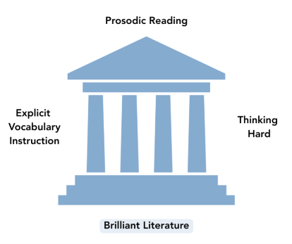
CUSP Reading has been purposefully built around the principles of evidence-led practice. The curriculum is built on three key foundations: explicit vocabulary instruction; explicit fluency instruction (prosodic reading) and opportunities to think hard. Every unit follows a clear and progressive sequence that immerses pupils meaningfully in rich and demanding texts that have been carefully curated. Pupils have the opportunity throughout the Primary journey to experience a wide range of literature, as well as studying extended texts in full. This ensures both breadth and depth in their reading diet.
CUSP Reading blocks:
Every year group has 18 blocks of Reading, each lasting 2 weeks. This means that some texts will be read in just one 2-week block, for example shorter picture books. Other books, such as extended novels, may be read over more than one 2-week block. The structure of a CUSP Reading lesson has been carefully designed to ensure that pupils receive a coherent, balanced and meaningful reading experience in every block. While the CUSP Reading curriculum is rooted in children reading whole, high-quality texts, we also recognise the importance of reading broadly so that pupils have the knowledge and skills to access reading in the wider curriculum. While it is impossible to isolate individual reading competencies, each day has been designed to target key competencies in the way that pupils respond to what they have read. The Key Stage 2 structure is outlined below:
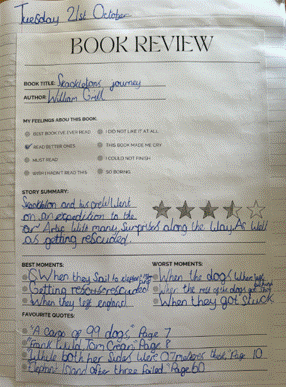
- On day 1 of each block of Reading, pupils will read the core text. This is the book that pupils are studying. The first days always designed to encourage pupils to summarise, compare and predict.
- Every day of the sequence includes explicit vocabulary instruction and an opportunity to develop pupils’ reading fluency through our prosodic reading strategies. This includes low stakes timed exercises on day 3 of each week to gradually build pupils’ pace and stamina over time.
- The first week of each block is designed to help pupils understand the detail of the text. The second week of each block is designed to help pupils think deeply about the texts.
- On days 2 and 3 of each week of the sequence, pupils will read supplementary texts that have been deliberately written to connect to the core text. This provides breadth and background knowledge.
- On the fourth day of each week, pupils will read one of the supplementary texts alongside the core text. This helps them to make connections and build strong schemas about what they have read.
- The fifth day of each week encourages pupils to develop their own personal responses to what they have read, exploring key themes and literary styles.
The CUSP curriculum is underpinned by a series of big ideas. These are key concepts that are not taught in isolation but, instead, have been deliberately and intricately woven into the warp and weft of the whole curriculum. We selected the big ideas that we believe are crucial for children living in modern Britain and beyond to make sense of.
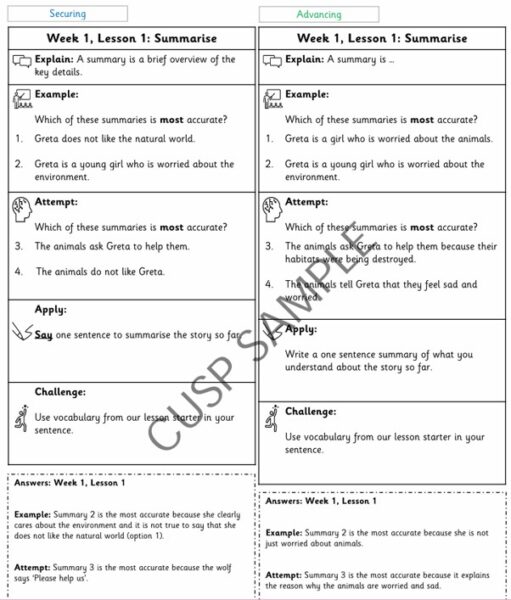
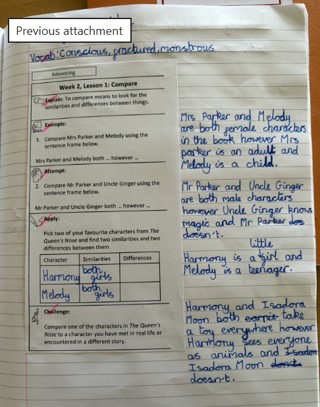
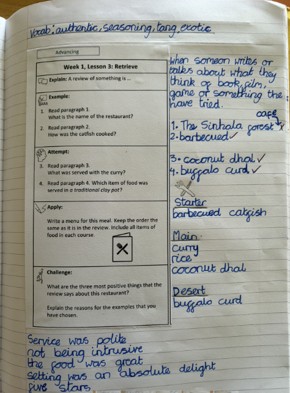
In CUSP Reading, Knowledge Notes are used to support teachers and pupils to navigate the instructional phases of the lesson. Teachers use them as a locational cue to support pupils in understanding which phase of the lesson they are in.
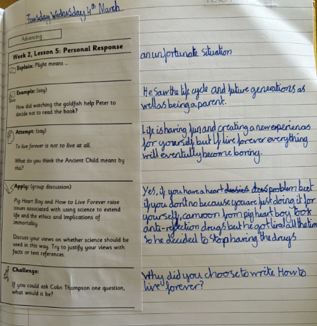
- In the Example phase, the teacher models responding to the question, demonstrating their thinking through Thinking Talk.
- In the Attempt phase, the teacher guides pupils through responding to the same type of question by applying the modelled strategy from the previous example.
- The Apply task utilises the same competency but with a change to the question framework to promote conceptual fluency – the ability to apply the same knowledge and understanding in different forms.
- The Challenge task is for all pupils and is designed to promote deep thinking about what pupils have read. This will also be rooted in the same core competency as the rest of the lesson. Many teachers use this as a fantastic opportunity to promote oracy and high-quality discussion.
Read Write Inc support resources for parents
Introduction to Read Write Inc for parentsFAQ by parents Read Write Inc information
Set 1 sounds parents informationSet 2 and 3 information for parents
set-2-and-3-sounds-parent-handoutFred_talk_parent support information
Parent_information reading_stories_to_children
listening_to_your_child_read_parent_meeting-1
CUSP Writing
Curriculum context: At St George’s Junior School, we believe that a high-quality English education is essential to pupils’ academic and personal development. English enables pupils to communicate effectively, develop their creativity, and participate fully in society.
A designated literacy lead coordinates reading and writing across the school, including responsibility for ongoing staff training in effective writing pedagogy, monitoring and support. The CUSP curriculum ensures a whole-school approach starting in Year 3 and applied consistently. The CUSP framework ensures a broad, balanced, and progressive sequence of learning in reading, writing, spelling, grammar, and spoken language.
Sequence and progression : CUSP Writing is built on a Reduce and Revisit model. This means that we have reduced the number of text types that pupils study, in favour of revisiting a small number that we want them to truly master. These text types have been carefully selected to ensure balance and progression across the whole of the primary journey.
The CUSP curriculum is underpinned by a clear programme of study that sets out what pupils should know and be able to do in each domain of writing. This is fully aligned to the National Curriculum. These concepts are mapped into each block of writing planning, with plenty of opportunities to revisit previous knowledge.
Teaching and learning: The CUSP curriculum ensures a whole-school approach starting in Year 3 and is applied consistently. The CUSP framework ensures a broad, balanced, and progressive sequence of learning in reading, writing, spelling, grammar, and spoken language.
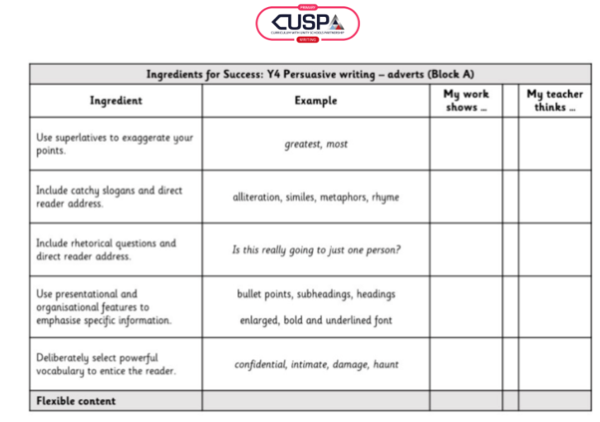
Each unit has an Ingredients for Success checklist. Teachers and pupils use this to support their assessment of the extended outcome. Teachers use these to support their marking and feedback of the extended outcome, identifying concepts which are secure and can be built on and those that require additional instruction.
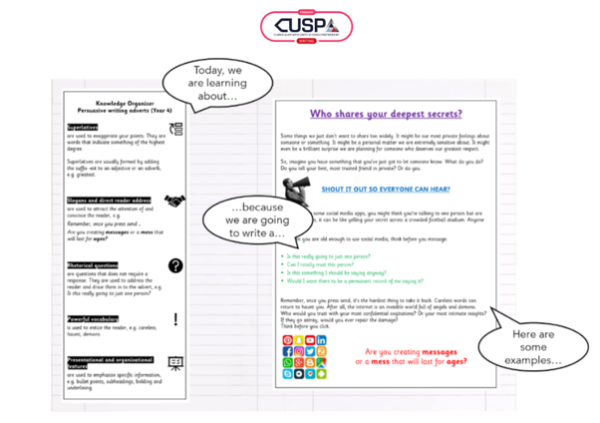
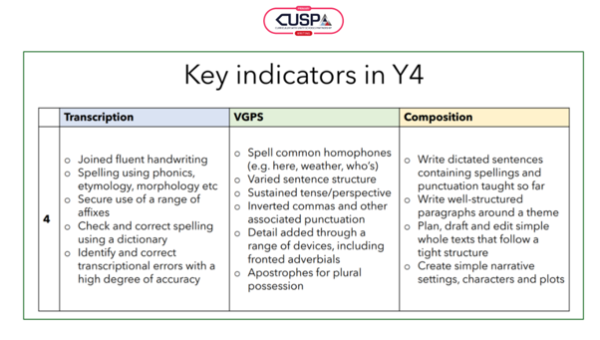
We use the Key Indicators as a summative tool that can be used to answer the question ‘Have pupils learned what is intended in the curriculum?’. If, across the portfolio of Block B units, pupils can show security against all elements of the Key Indicators, pupils have learned what is intended. If there are gaps for individuals, this information can be used to reshape practice and support teachers in addressing areas of weakness for individual pupils or cohorts.
Spelling
Intent: The spelling curriculum at St George’s is designed to embed a strong understanding of phonics, morphology and etymology. Children are enthused and engaged to explore spelling patterns, learn about words in context, develop strategies and embed these spellings through their writing.
Implementation:
- On entry to St. George’s, year 3 children are assessed and any gaps in their phonic knowledge are identified. Gaps in children’s phonic knowledge are closed through targeted intervention groups and are continued throughout key stage two.
- Spelling at St. George’s follows the sequence set out in the National Curriculum. Each year uses the Read Write Inc. scheme to compliment the progressive teaching and learning of spelling.
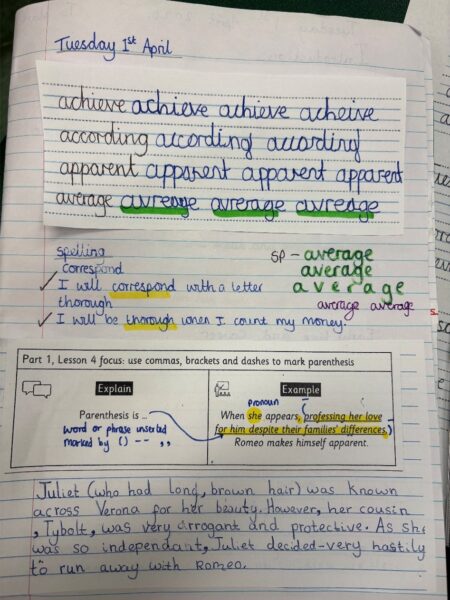
- Across the school, children are regularly assessed and are given spellings tailored to suit their spelling age. Children are set weekly spellings which they practice at home and in class. These spellings are linked to spelling patterns that are taught and vocabulary that is used across the curriculum.
- Our progressive spelling lessons intend to move children on in their orthographic understanding by targeting specific gaps in their spelling knowledge; exploring patterns and rules in spelling investigations and by using a variety of strategies to help support all learners. During lessons children are encouraged to articulate words, patterns and processes previously learned, this metacognitive approach enables knowledge to move from short-term to long-term memory.
- Children are encouraged to use a wide range of resources to support spelling learning and application. Children have access to dictionaries and thesauruses and are encouraged to use these as a matter of habit; the use of these is modelled through teaching regularly.
Spelling Progression Grid