Religious Education
Intent
To develop children’s awareness and tolerance of different religions and cultures in their local community and the wider world.
Using the Discovery RE Syllabus as an underlying structure to form the basis of our planning, our pupils are given opportunities to:
- understand, explain and appreciate the beliefs and practises of world religions, significant religious celebrations and world festivals through a variety of learning experiences
- recall, articulate and build upon knowledge of key religious terminology.
- critically analyse religions, cultures and communities from the wider world alongside their own beliefs, values and experiences.
- acknowledge and develop their personal beliefs, values and identify by drawing upon their understanding of world diversity.
- become tolerant citizens in preparation for life in the local community and wider world.
Implementation
To ensure high standards of teaching and learning in RE, we implement a progressive curriculum based on the key questions from the Shropshire Agreed Syllabus which we deliver using the scheme, ‘Discovery RE’.
We use an enquiry-based approach to teaching and learning to learn about some of the different religions in the world and to learn from religion, i.e. to reflect and explore questions about spirituality at the child’s own level. The exploration of questions is largely covered through discussions and sharing of ideas. The questions are both stimulating and challenging and provide opportunities for children to gain important insights into their own beliefs and values as well as those represented in the religions being studied.
Christianity, Hinduism, Islam, Judaism and Sikhism are taught during Key Stage 2. Christianity is taught in every year group, with Christmas and Easter studied each year, developing children’s learning in a progressive way and offering a spiral curriculum so the pupils revisit the core concepts several times in increasing depth.
The model we use for each enquiry topic is – Engage – Investigate – Evaluate – Express.
Engage: Lesson 1 aims for pupils to resonate with their experience underpinning the key question. Their personal resonance with this underpinning human experience acts as the bridge into the world of religion (which may be outside of their experience).
Investigate: Pupils gain subject knowledge to assist their thinking about the key question.
Evaluate: Pupils draw together their learning and conclusions about the key question of the enquiry. This involves assessment tasks.
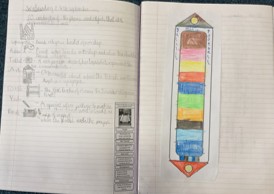
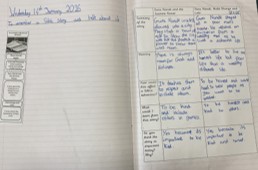
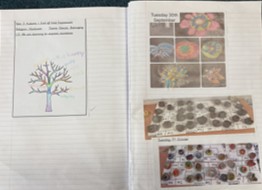
Expression: Pupils are taken back to step 1, their own experience, to reflect on how this enquiry might have influenced their own starting points and beliefs. There is often further evidence for their books produced in this lesson.
RE also incorporates the CUSP curriculum (Curriculum with Unity Schools Partnership) which is a research‑informed, knowledge‑rich primary curriculum. It is built on cognitive science, explicit vocabulary instruction, and carefully sequenced learning to improve outcomes for all pupils.
How do we learn?
CUSP draws on research in:
- Cognitive science
- Retrieval practice
- Spaced practice
- Interleaving
- Explicit vocabulary instruction
This allows for topics to be revisited within a year group and across a key stage, enabling deep thinkers who have a strong understanding of their learning and the world around them.
Impact
At the end of each unit, children are given an assessment sheet where they reflect on their learning, other people’s believes and their own. Then children complete a self-expression sheet where they can showcase how their learning can support them.
In lessons, teachers will assess understanding through discussion and completed work.
|
Autumn 1 |
Autumn 2 |
Spring 1 |
Spring 2 |
Summer 1 |
Summer 2 |
| Year 3 |
Hinduism
Key Question: Would celebrating Diwali at home and in the community bring a feeling of belonging to a Hindu child? |
Christianity
Key Question:
Has Christmas lost its true meaning? |
Christianity
Key Question: Could Jesus really heal people? Were these miracles or is there some
other explanation? |
Christianity
Key Question: What is good about good Friday? |
Hinduism
Key Question: How can Brahman be everywhere and everything? |
Hinduism
Key Question: Would visiting the River Ganges feel special to a non-Hindu? |
| Year 4 |
Judaism
Key Question: How special is the relationship Jews have with God? |
Christianity
Key Question: What is the most significant part of the Nativity story for Christians
today? |
Judaism
Key Question: How important is it for Jewish people to do what god asks them to do? |
Christianity
Key Question: Is forgiveness always possible? |
Christianity
Key Question: What is the best way for a Jew to show commitment to God? |
Christianity
Key Question: Do people need to go to church to show they are Christians?
|
| Year 5 |
Sikhism
Key Question:
How far would a Sikh go for his/her religion? |
Christianity
Key Question: Is the Christmas story true? |
Sikhism
Key Question:
Are Sikh stories important today? |
Christianity
Key Question: Did God intend Jesus to be crucified and if so, was Jesus aware of this? |
Sikhism
Key Question:
What is the best way for a Sikh to show commitment to God? |
Christianity
Key Question: What is the best way for a Christian to show commitment to God? |
| Year 6 |
Islam
Key Question:
What is the best way for a Muslim to show commitment to God? |
Christianity
Key Question: How significant is it that Mary was Jesus’ mother? |
Christianity
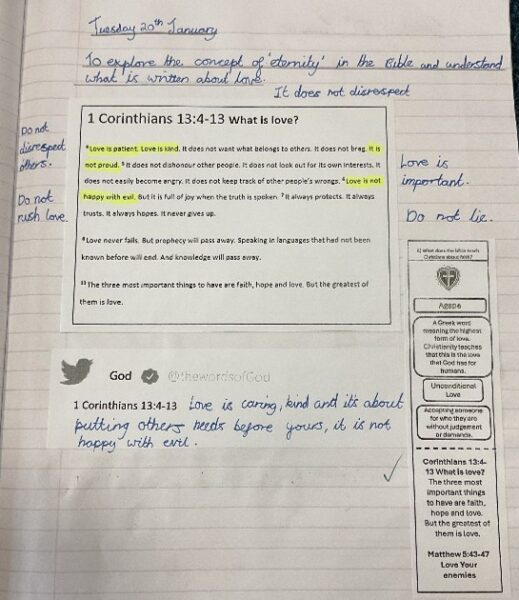
Key Question: Is anything ever eternal? |
Christianity
Key Question: Is Christianity still a strong religion 2000 years after Jesus was on Earth? |
Islam
Key Question:
Does belief in Akhirah (life after death) help Muslims lead good lives? |
|